



When choosing sportswear, the fabric is just as important as the design. It influences how clothing feels against the skin, how it handles perspiration, how well it withstands repeated use and how comfortable it remains during physical activity.
Two of the most widely used synthetic fibres in sportswear are polyester and nylon. Both offer valuable properties for athletic clothing, but they have different strengths. Polyester generally performs better in moisture management and low moisture absorption, while nylon stands out for its abrasion resistance, toughness and natural elasticity.
So, which one should you choose?
Understanding their differences will help you identify which material is better suited to your training needs, whether you are running, working out at the gym or participating in outdoor sports.
What Is Polyester?
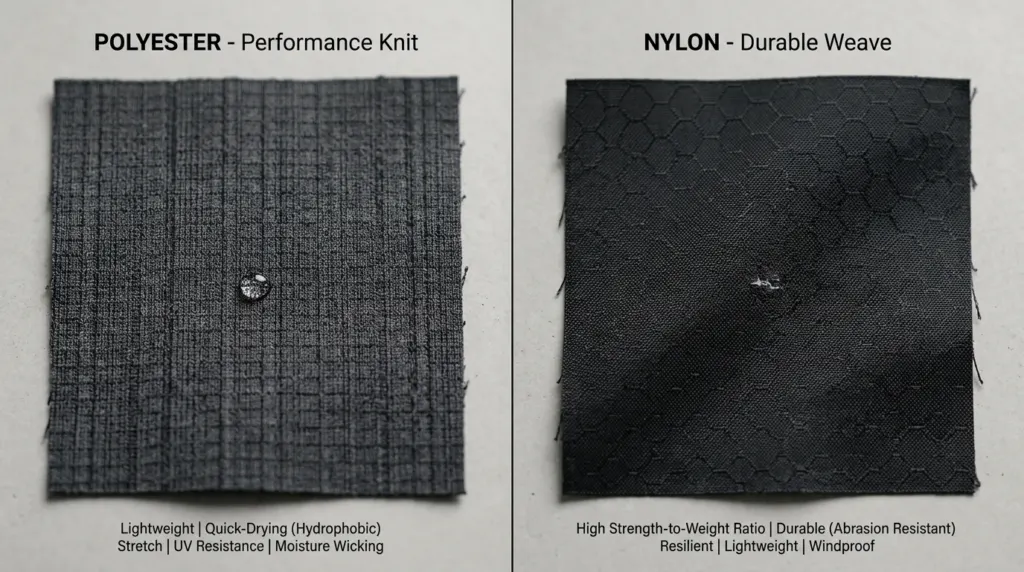
Polyester is a synthetic fibre made from polymer-based materials. It has become one of the most widely used materials in the textile industry because of its versatility, durability and low moisture absorption.
One of its biggest advantages is that it absorbs very little moisture into its fibres. This makes polyester particularly useful for sportswear, where managing perspiration and maintaining a lightweight feel are important.
Polyester also offers good dimensional stability, meaning garments generally retain their shape after repeated washing and use.
Common characteristics of polyester include:
- Low moisture absorption.
- Good durability and dimensional stability.
- Generally quick-drying potential.
- Good resistance to everyday wear.
- Versatility in different fabric constructions.
- Relatively easy maintenance.
Polyester is commonly used in running shirts, training tops, sports shorts, football uniforms, tracksuits and other technical garments — such as the Shift T-Shirt Man, made from a polyester and elastane blend.
What Is Nylon (Polyamide)?
Nylon, also known as polyamide, is another synthetic fibre widely used in performance textiles.
It is particularly valued for its strength, toughness and resistance to abrasion. These properties make it suitable for garments that experience frequent friction, stretching and demanding physical use.
Compared with polyester, nylon absorbs more moisture. However, it also offers excellent elasticity and recovery, allowing fabrics to stretch and return towards their original shape. Its smooth surface is another characteristic that makes it popular in close-fitting garments.
Common characteristics of nylon include:
- High tensile strength and toughness.
- Excellent abrasion resistance.
- Good natural elasticity and recovery.
- Smooth surface and comfortable feel.
- Greater moisture absorption than polyester.
- Versatility in technical garments.
Nylon is frequently used in leggings, compression garments, sports bras, swimwear, outdoor clothing and other performance-oriented products, such as the Shift Leggings Woman in a polyamide and elastane blend.
Polyester vs. Nylon: Key Differences
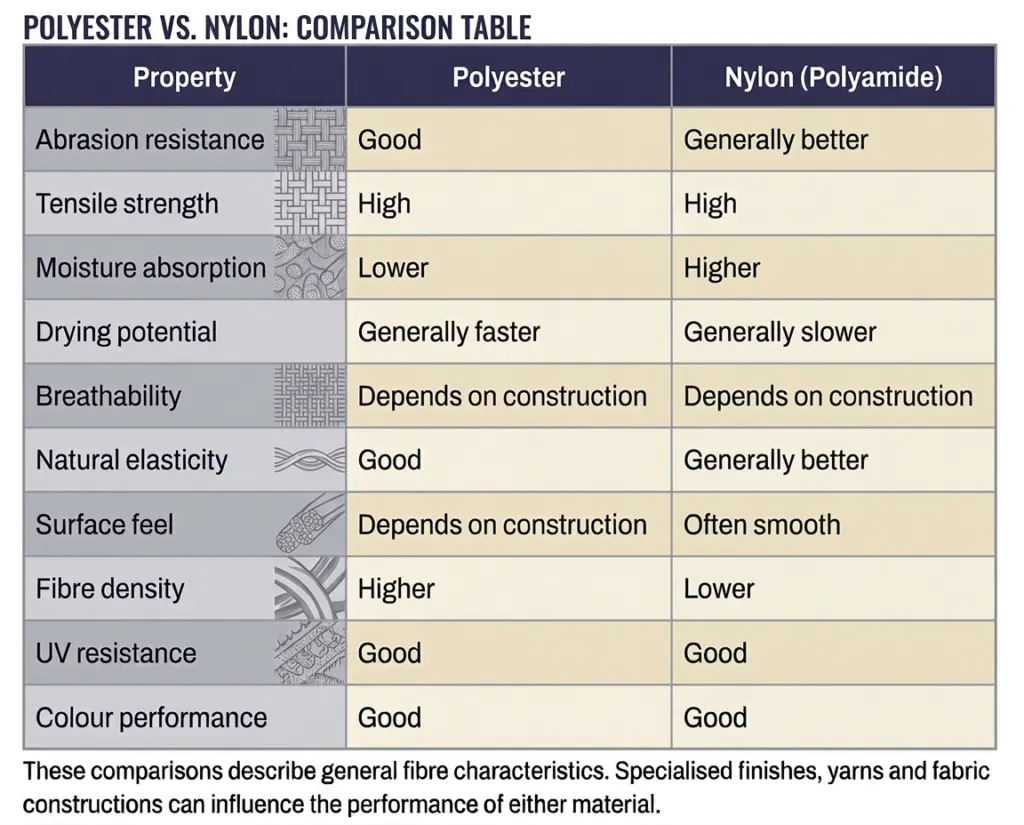
Although both fibres are suitable for technical sportswear, their individual properties make them better suited to different applications.
Let’s examine the most important differences.
1. Durability and Abrasion Resistance
Nylon generally has better abrasion resistance and toughness than polyester. It can withstand repeated friction and demanding physical use, making it particularly suitable for leggings, outdoor apparel and garments exposed to frequent contact with equipment or rough surfaces.
Polyester is also a durable material and performs well in everyday sportswear. It offers good resistance to wear and maintains its shape through repeated use.
However, when resistance to rubbing, surface damage and mechanical stress is the main priority, nylon generally has the advantage.
2. Moisture Management and Drying
Moisture management is one of the most important considerations when choosing sportswear.
During physical activity, the body produces perspiration to regulate its temperature. Clothing should help move that moisture away from the skin and allow it to evaporate.
Polyester absorbs very little moisture into its fibres, generally less than 1% of its dry weight under standard moisture-regain conditions. Nylon typically has a moisture regain of around 4–4.5%.
This difference gives polyester an advantage: it retains less moisture within the fibre itself and generally has better quick-drying potential.
Nylon can also be engineered to transport perspiration effectively, but its higher moisture absorption means it tends to retain more water within the fibres.
It is important to distinguish moisture absorption from moisture wicking. Absorption describes how much moisture a fibre takes in, while wicking describes how effectively a fabric transports liquid across its structure.
For lightweight sportswear where low moisture absorption and quick drying are priorities, polyester is generally the better choice.
3. Breathability and Comfort
Breathability determines how effectively air and water vapour can move through a garment. It plays an important role in maintaining comfort, particularly during intense physical activity.
Neither polyester nor nylon is automatically more breathable in every application. The structure of the fabric plays a major role in determining how much air can pass through it.
Polyester is widely used in lightweight mesh fabrics and training garments designed for ventilation. Nylon can also be manufactured into highly breathable constructions, including lightweight knitted fabrics.
In terms of comfort, nylon is often selected for its smooth surface and suitability for close-fitting garments, while polyester is particularly common in lightweight training shirts and sports uniforms.
The practical choice depends on the garment: for breathable training shirts, both materials can perform well. but for fitted apparel, nylon often has an advantage in surface feel.
4. Stretch and Flexibility
Flexibility is essential in sportswear because garments need to accommodate natural body movement without restricting the wearer.
Nylon generally has greater natural elongation and elasticity than conventional polyester fibres. It also offers good elastic recovery, meaning it can return towards its original shape after being stretched.
This makes nylon particularly suitable for fitted garments such as leggings and compression apparel.
However, elastane is often more important than the base fibre when designing highly stretchable sportswear. Both polyester and nylon can be blended with elastane to produce flexible leggings, compression garments and fitted training apparel.
When comparing the base fibres alone, nylon generally has the advantage in natural elasticity.
5. Weight and Feel
Both polyester and nylon can be manufactured into lightweight fabrics, but they have some differences in their physical properties.
Nylon has a lower fibre density than conventional polyester. For an equal volume of fibre, nylon weighs less. It is also often associated with a smooth surface and soft feel, making it attractive for close-fitting sportswear.
Polyester is highly versatile and can be manufactured into very lightweight fabrics, including breathable mesh and technical materials used in running shirts and sports uniforms.
However, the weight of a finished garment also depends on fabric thickness, yarn construction and the amount of material used.
Nylon has the advantage in fibre density, while polyester offers considerable versatility in lightweight sportswear applications.
Which Fabric Is Better for Different Sports?
Understanding the technical differences is useful, but the most important question is how these materials perform in actual, real life, sporting applications.
Running and Endurance Training
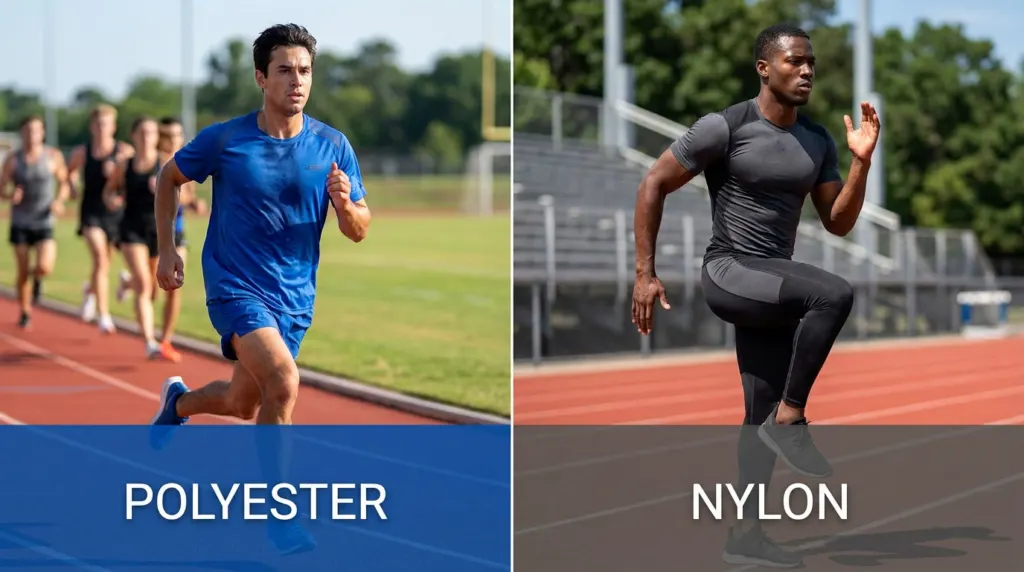
Polyester is generally the preferred choice for running apparel. Its low moisture absorption and quick-drying potential make it particularly suitable for running shirts, shorts and lightweight training tops.
Nylon is also used in running clothing, particularly in fitted garments where flexibility and a smooth feel are desirable.
For lightweight running apparel, polyester is usually the more practical option.
Gym and Strength Training
Both materials work well for gym clothing, but their applications often differ.
Polyester is particularly suitable for training shirts and lightweight tops because of its low moisture absorption and breathability.
Nylon meanwhile is frequently used mostly in leggings and fitted training garments because of its abrasion resistance, smooth feel and natural elasticity.
For a general training shirt, polyester is a strong choice. For close-fitting leggings, nylon is often preferable.
Yoga and Flexibility Training
Nylon is particularly popular in yoga clothing because of its smooth feel, flexibility and ability to recover after stretching. Unsurprisingly, many yoga leggings — such as those in the UNTAMED @GYM line — combine polyester or polyamide with a significant percentage of elastane.
When combined with elastane, it can create comfortable, flexible garments that accommodate a wide range of movements.
Polyester and elastane blends can also provide excellent stretch and durability, making them a suitable alternative.
For soft, close-fitting yoga apparel, nylon is generally a strong choice.
Outdoor and Hiking Activities
Outdoor activities place different demands on clothing, particularly when garments are exposed to friction, sunlight and changing weather conditions.
Nylon is commonly used in outdoor apparel because of its excellent abrasion resistance and toughness. It is particularly suitable for garments exposed to repeated contact with backpacks, equipment and rough surfaces.
Meanwhile polyester offers lower moisture absorption and is widely used in lightweight outdoor clothing, often combined with nylon for a better experience.
For garments where abrasion resistance is the priority, nylon is generally preferable. For lightweight outdoor apparel, polyester is also an excellent option.
Team Sports
Polyester is particularly common in football, basketball, volleyball and other team sports.
Its lightweight properties, low moisture absorption and suitability for sublimation printing make it a practical material for team uniforms.
It is also widely available in different fabric constructions, allowing manufacturers to produce everything from lightweight match jerseys to more substantial training garments.
For team uniforms and training apparel, polyester is generally the preferred material. If you are considering custom kits for your team, take a look at how the DOMINER’S kit customize process works.
Can Polyester and Nylon Be Blended With Other Fibres?
Yes. Blending synthetic fibres is one of the most common ways to develop fabrics with specific performance characteristics.
One of the most frequently used combinations is polyester or nylon with elastane.
Elastane provides significant elasticity, allowing garments to stretch during movement and recover their original shape.
Some common combinations include:
- Polyester and elastane: Frequently used in fitted sportswear, training garments, cycling clothing and flexible athletic apparel.
- Nylon and elastane: Common in leggings, compression garments, sports bras and close-fitting performance clothing.
- Polyester and other fibres: Used to achieve particular textures, moisture-management characteristics and fabric properties.
The percentage of each fibre influences the final characteristics of the fabric. A garment with 75% polyester and 25% elastane will have different stretch properties from a piece made with 72% polyamide and 28% elastane, and different again from one made with 100% polyester.
Blending allows manufacturers to combine the strengths of different fibres rather than relying on a single material. combine the strengths of different fibres rather than relying on a single material.
So, Which Fabric Should You Choose?
There is no single material that is best for every sporting activity. However, their different characteristics make the choice relatively straightforward in many situations.
Choose polyester when:
- You need lightweight clothing for running or regular training.
- Low moisture absorption and quick drying are priorities.
- You need sportswear for outdoor activities.
- You are looking for team uniforms suitable for sublimation printing.
- Easy maintenance and dimensional stability are important.
Choose nylon when:
- Abrasion resistance is particularly important.
- You prefer a smooth and soft fabric feel.
- You need fitted garments with good natural elasticity.
- Your clothing experiences repeated friction and demanding movement.
- You are choosing leggings, compression garments or technical outdoor apparel.
Final Thoughts
Polyester and nylon have both become essential materials in modern sportswear, but they serve different purposes.
Polyester stands out for its low moisture absorption, quick-drying potential and versatility in lightweight sportswear. These characteristics make it particularly suitable for running apparel, training shirts and team uniforms.
Nylon offers excellent abrasion resistance, toughness, elasticity and a smooth feel, making it particularly useful in leggings, fitted sportswear and demanding outdoor applications.
Ultimately, choosing the right material means understanding what you expect from your clothing. The best sportswear is not necessarily made from the strongest or most expensive fibre, but from materials selected to meet the demands of the activity.
At DOMINER, we believe that performance starts with understanding the details. The right materials, thoughtful design and functional construction all contribute to sportswear designed to support movement, training and the pursuit of personal goals.